Learning Online about Hiapo
I am very inspired by the hiapo patterns that I have seen so far and want to know much more about them. I recently bought a book: Hiapo Past and Present in Niuean Barkcloth by John Pule and Nicholas Thomas (2005) and have been fully immersed in it (since it arrived on 27th January).

Example drawing on origami paper
I started trying to draw some of the patterns myself, but found I couldn’t see them all clearly in the pictures of the book, so first off I was thinking of ways to enlarge them. Scanning or photographing and then blowing up the image was one idea, but the print dots just come in to view. So I thought I would do a search to see whether there are any images available online that are high enough resolution to enlarge.
I also wanted to see if there are any examples that I might have a chance of seeing in real life – so they would need to be in the UK. I was wanting to get a sense of scale. I know the dimensions of the pieces are given in the images, but imagining that and actually seeing it are two different things. I was trying to reproduce a square within a piece onto paper about 2 inches square. Whereas those sections on the original are somewhere in the region of 26-32cm or larger even I calculated.
British Museum Collection
First I found some that are available online in the British Museum Collection. Unfortunately that sidetracked me into looking at other objects available in the online collection.

British Museum Caption: “Rectangular sheet of barkcloth decorated in dark brown ink with designs in square panels, primarily combined plant and geometric forms. One panel depicts a European woman in bonnet and crinoline dress, mid-nineteenth century style.” CC BY-NC-SA 4.0 British Museum. This appears on Page 107 of the Hiapo book. For more info click on picture to take you to the British Museum page for this object.
At some other point I will add a list to this blog of all of the items of interest that I found in that online collection.
What about the women artists?
The book is great with so many amazing photographs that it is like a catalogue. I am however disappointed by the writing. In particular disappointed about 2 aspects. Firstly that there wasn’t any talk about the process of how these bark cloths (also referred to as tapa) were made, because I think the method of making has a big bearing on understanding the designs. And secondly that there is no mention of the fact that it is most likely women who made them and in some kind of collective process. Well I am saying that because I have watched some videos, which I will put below.
It should be said that this book was published in 2005 and says it was ten years in the making – so 1995-2005. Well the internet then was not as it is now and there will not have been so many places to find as much information. However, they talk about visits to Niue meeting with elder men to ask them about the cloths and yet they do not mention talking to any women. Perhaps they would have found out more if they had.
The following is a playlist of 5 informative videos about Tongan Tapa making:
And this is from another source also showing the Tongan Tapa making:
Whilst these are not specifically about Nuie, it would be hard to believe that the process of making the barkcloth there would be significantly different.
I have found other videos about barkcloth made in Uganda. This Ugandan barkcloth is made from a different tree bark and seems to be predominantly made by men, but by basically the same process of stripping the bark then hitting it with wooden mallets against a large log (see below for tapa making process). The Ugandan barkcloth, though, is often used just dyed one solid colour without a pattern, and, if it does have decoration, the patterns are quite different to the hiapo or other South Pacific tapa. As I was checking video links to add to this blog post, I found another video about Tongan tapa which I have put further down this post, although that one is actually the best quality.
Making Tapa Cloth (Barkcloth)
These notes are taken from the commentary of the videos above.
No-one knows precisely when tapa (barkcloth) came to the Pacific, but it was almost certainly brought by travellers who brought the Mulberry Tree, which is the source of the cloth and paper. Originally from South East Asia, the plant first took hold in the islands north of Australia before spreading the length and breadth of the Great Ocean. The oldest known is from Indonesia then Papua New Guinea. From the northern coasts of New Guinea the ancestors of the Polynesians spread to other islands and took the Mulberry Tree with them. The Mulberry Tree doesn’t seed on the islands, it can only be propagated from cuttings, so the people were very careful to cultivate it.
Tapa making is practised across the islands of the South Pacific, but restricted to the high islands that have volcanic soil. The barkcloths are thought to fulfil social, spiritual and artistic functions. The tapa has different names on different islands.
The stalks of the Mulberry need to be long (about 2m) and straight for the best tapa. That means careful tending to pick of side shoots early while the stalks are growing. If the side shoots are left to grow too long that ends up being a hole in the bark that then needs to be patched when it has been beaten into the cloth.

Women have fun when beating tapa in Tonga. Uploaded by Tauʻolunga at en.wikipedia [Public domain], via Wikimedia Commons
The strips enlarge from the beating from 2″ wide to 6″. Then 2 pieces are beaten together and finally can end up with a piece several feet wide and very thin. Then the pieces are dried on a line. After that holes are patched with small scraps and a kind of starchy potato as glue. This is also used to glue pieces together to make the very large pieces at the later stages (although other glues are mentioned made from tapioca and flour and water paste).
Decorating the Tapa
Coconut fibres are used to make stencils to print on to the tapa. Like a kind of brass rubbing effect with raised lines. These are bound to a large board.

Kupesi pattern from Manulua Bookart project
In the film groups of 12 women get together with the pieces of cloth they have made then these get joined together with damp tapioca and a rag wet with dye is rubbed over to press in the patterns, which come through from the stencils underneath. That is the bottom layer, which is then smeared all over with glue and another layer of barkcloth is attached with the direction of the strips at right angles to give strength. That layer is also rubbed with the dye cloth. Senior women supervise. It takes several hours to make the piece. The activity is communal, with singing. The process of making the tapa binds the community together. The piece is huge now made from strips of cloth beaten by multiple women. It is taken out to dry by laying it on the ground and holding the edges down with rocks. Once dry it will be cut up and divided between the women (it says in the video).

Ready to rub the koka onto the fetaʻaki in ʻEua (Tonga) Uploaded by Tau’olunga at en.wikipedia [Public domain], via Wikimedia Commons, https://en.wikipedia.org/wiki/Tapa_cloth#/media/File:Taparub.jpg
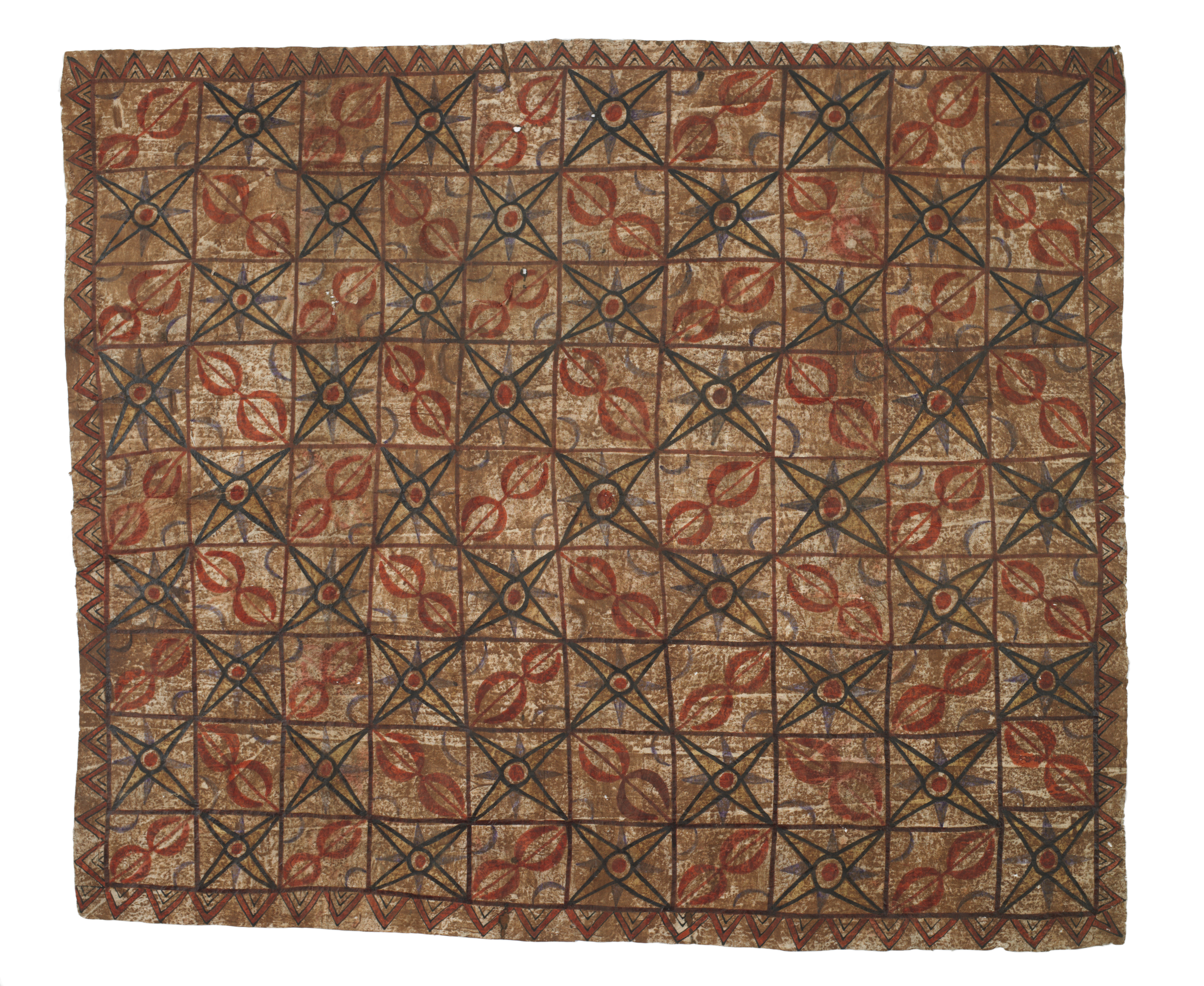
Siapo (tapa cloth), Samoan barkcloth, maker unknown. Gift of Mrs Lorna A Crawford, 1961. Te Papa (FE003511/2)
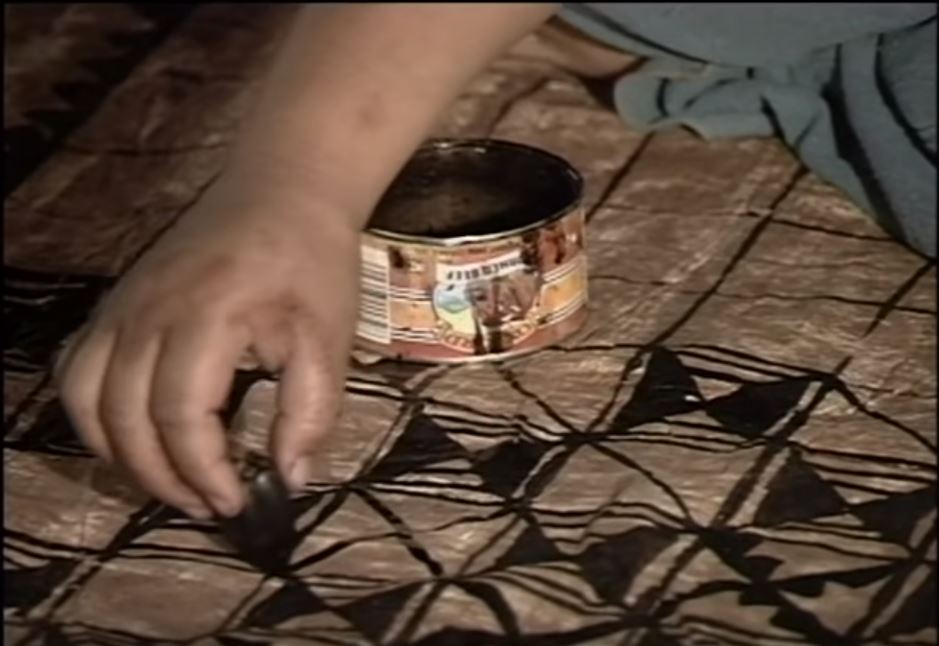
Hand painting using the sharpened nut
The burnt nuts from the candlenut tree produces a black oil that was once also used as a tattoo ink. It’s most frequent use is for hand painting already dyed tapa. In Tonga the most commonly used red dye is made from the bark of the koka tree. The candlenuts are also used as a brush to paint the black oil patterns on to the barkcloth, or the sharpened nut of the pendennis plant (think that is what she says, but can’t find any more detail of that yet).
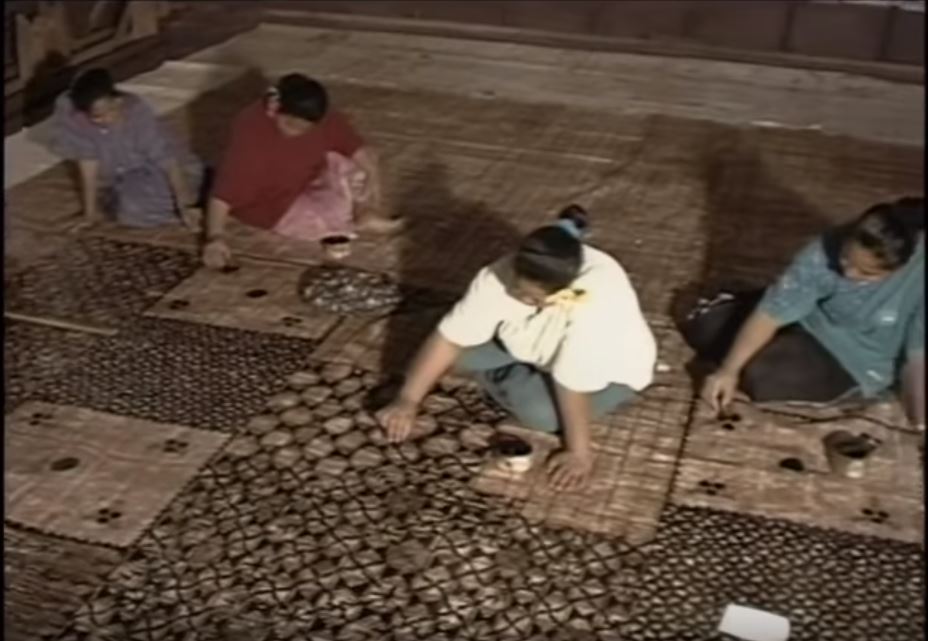
Screen grab women hand painting
Hand painting often involves highlighting the existing design from the previous stages or other times it is freehand. I have put some screen grabs from the videos here because I feel it illustrates the process that is most similar to the hiapo. Women sitting on the large cloth. The scale of it.
The previous video about the Tongan tapa also says that each pattern has a name and meaning. That information is also mentioned in a blogpost about a course in 2011 on Tonga which I have put in the references. (I wonder if there is a reference book or something online listing these names?)
Below is another short video about Ngatu Tonga. It is better quality and more modern than those I added earlier, but I only came upon it by YouTube suggesting it from the other videos I had watched. I think I will end this post here as being all about the production of tapa. This has given me greater understanding of what I am looking at in the pictures in the Hiapo book.
References
Book: Hiapo Past and Present in Niuean Barkcloth by John Pule and Nicholas Thomas (2005).
Cameron, Ewen. Paper mulberry: Prized across the Pacific. Auckland War Memorial Museum – Tamaki Paenga Hira. First published: 5 April 2016. Updated: 14 April 2016. http://www.aucklandmuseum.com/discover/collections/topics/paper-mulberry-prized-across-the-pacific
Book Arts in Tonga, part 1: Making the tapa cloth and koka dye (4 Feb 2011)
https://lilbookbinder.wordpress.com/2011/02/04/book-arts-in-tonga-part-1-making-the-tapa-cloth-and-koka-dye/
Book Arts in Tonga part 2: Learning Tongan Design and Making Books
https://lilbookbinder.wordpress.com/2011/03/31/book-arts-in-tonga-part-2-learning-tongan-design-and-making-books/


Recent Comments