Siga – men’s barkcloth headdress from Kulawi or Bada in Indonesia
Barkcloth patterns inspiration
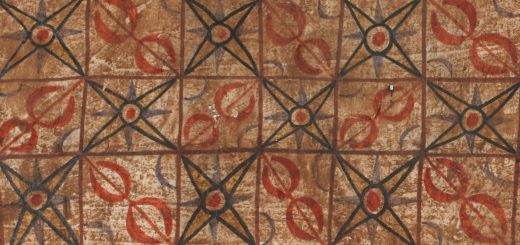
I found the barkcloth headdress artefact pictured below in the National Museums Scotland online collection. I was so interested in the pattern that I was compelled to study it in great detail and to try to produce my own version.
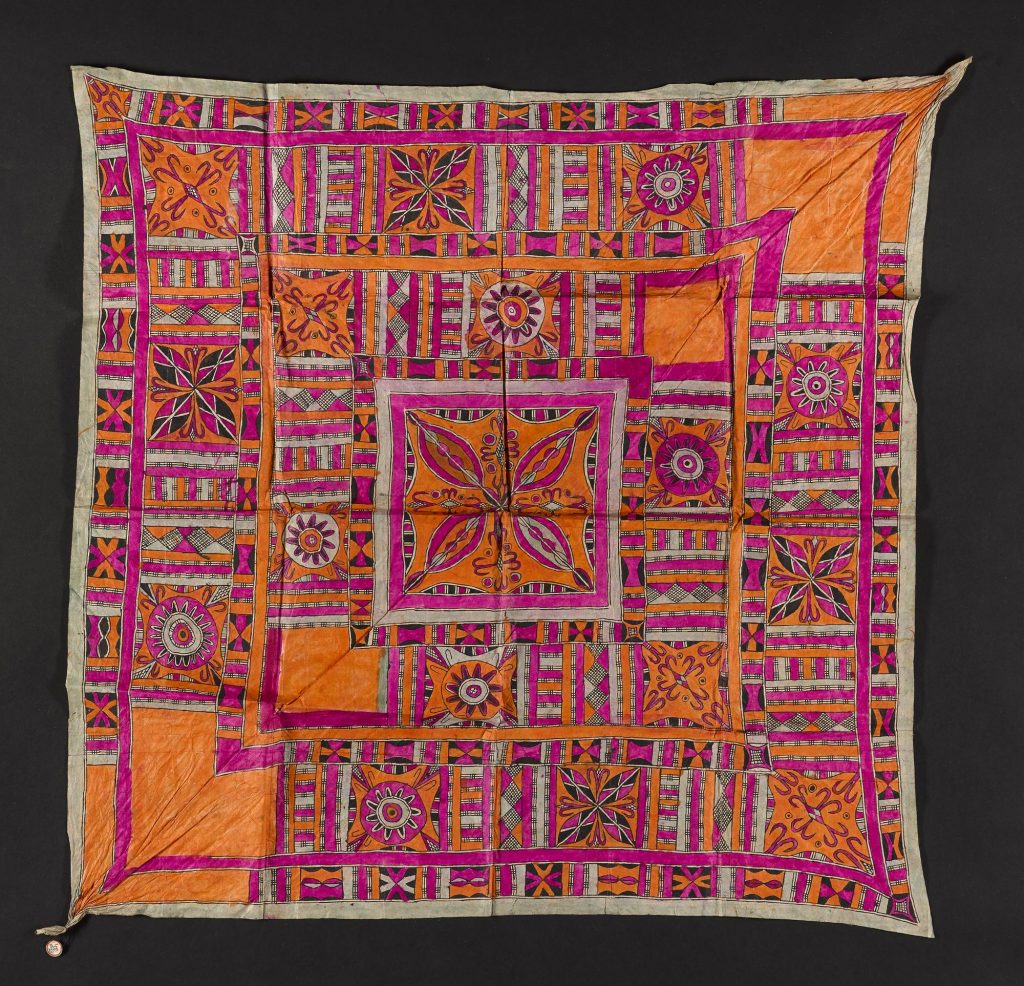
Museum Description: “Siga or men’s headdress of barkcloth, painted with a brightly coloured pattern, worn at feasts: Asia, South East Asia, Indonesia, Central Sulawesi, Kulawi or Bada, early 20th century”
Although on first look this piece seems square I notice that the corners are elongated outwards to more of a point. Has it been stretched or was it made that shape with pointed corners? It looks more to me that it was designed that way rather than having been distorted also I don’t think that the barkcloth would be very flexible to stretch like that. That raised other questions. How was it worn? Was it folded into a triangle and tied at the front or back or under the chin? The only example I have found so far of someone wearing a siga is on instagram below, which suggests representing horns to me, which is plausible, but something quite different than I had thought. .
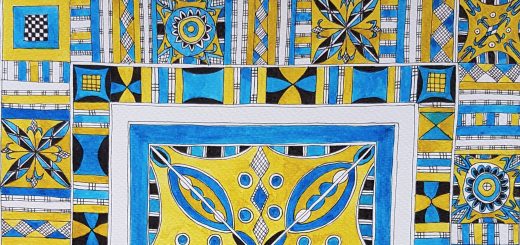
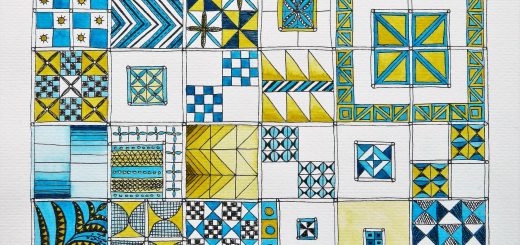
Below is the first piece that I produced inspired by it and I am already midway through a second.
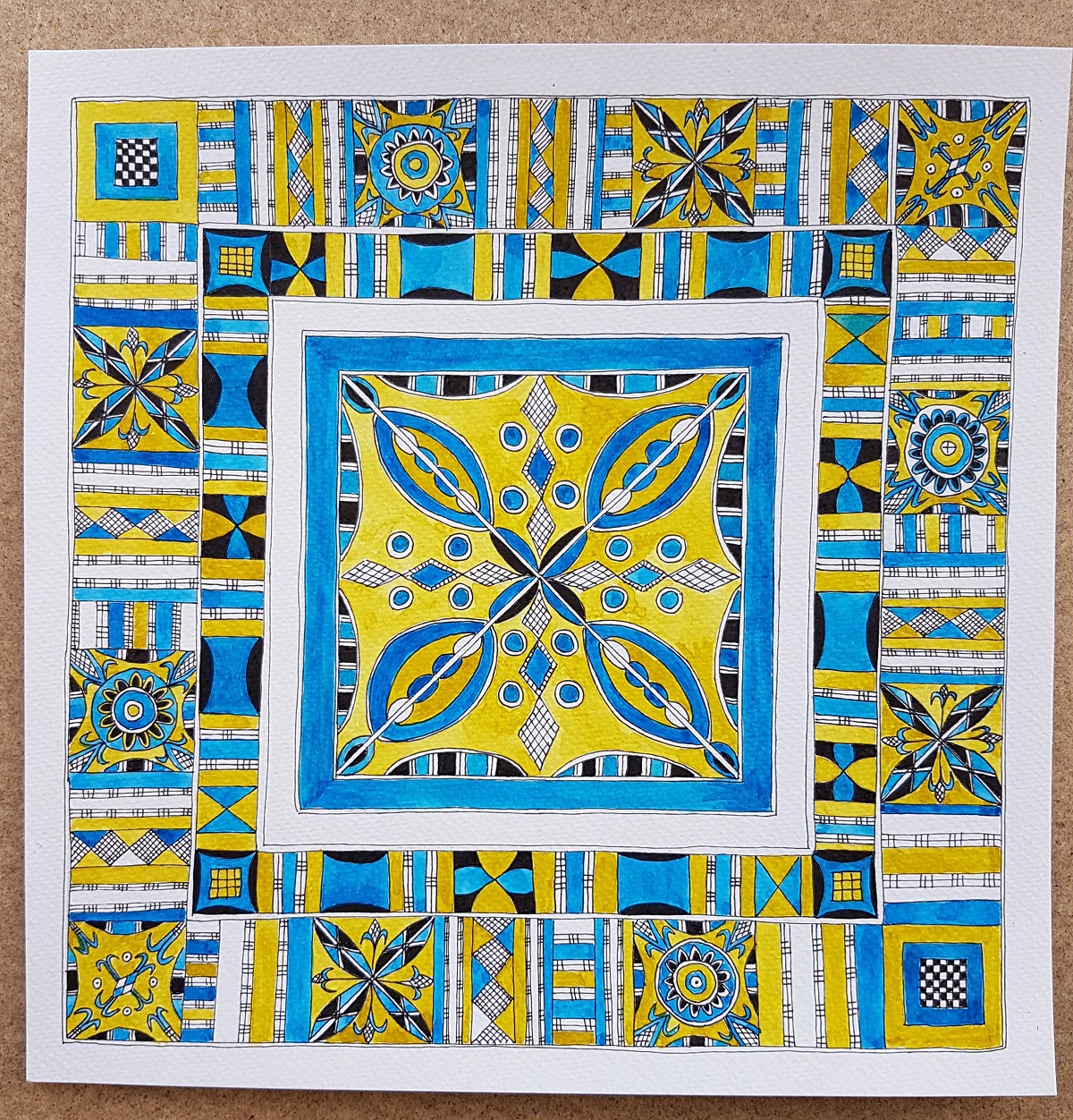
Siga inspired – Water colour and ink on 300gsm water colour paper 30x30cm
I really want to record all of the things I am finding out about barkcloth and these kind of patterns, but it is so time consuming. I can see why pinning things on a Pinterest board would make sense, but I want to consider each piece in more depth and make connections and commentary. For my own study purposes I have been saving things in OneNote.
For this post I will just add some more examples of siga and other information that I have found.
Other Examples from National Museums Scotland online collection
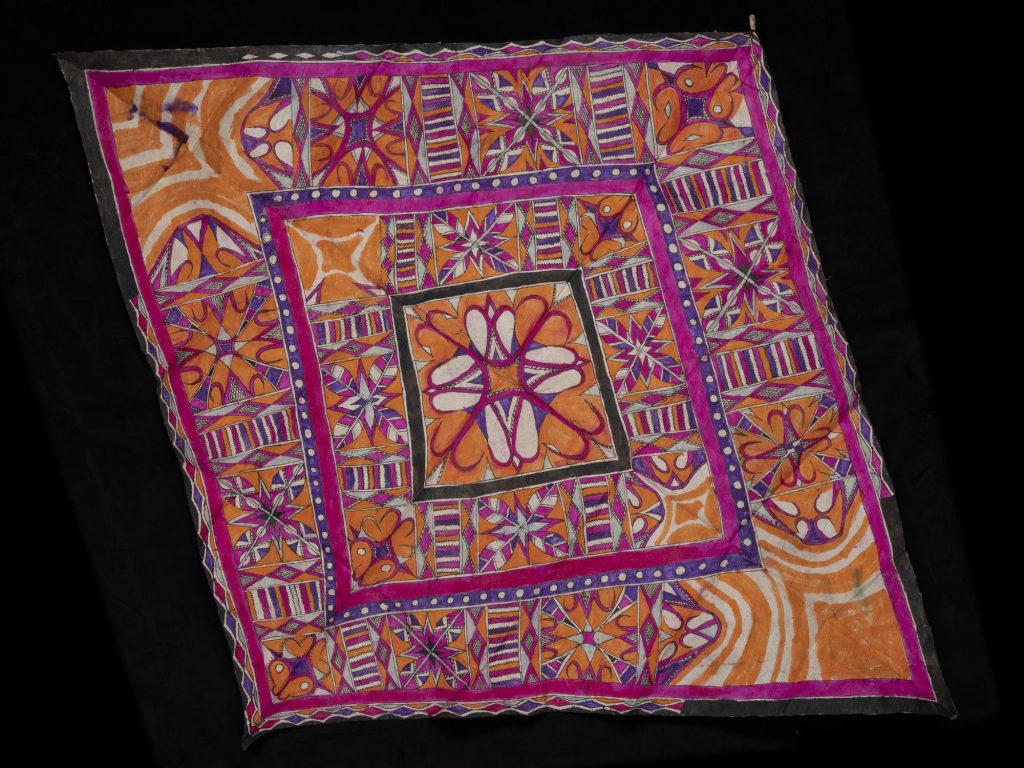
Museum Description: Siga or men’s headdress of barkcloth, painted with a brightly coloured pattern, worn at feasts: Asia, South East Asia, Indonesia, Central Sulawesi, Kulawi or Bada, early 20th century
The example above has similar motifs and colours. Well it has an additional colour and less solid black just lines – the colours are orange, pink, purple, white, black. This one is more definitely diamond shaped and has more decorations at the corner edge that would not be hidden by a knot. I find the design less pleasing, but cannot put my finger on why.

Museum Description: Siga or men’s headdress of barkcloth, painted with a brightly coloured pattern, worn at feasts: Asia, South East Asia, Indonesia, Central Sulawesi, Kulawi or Bada, early 20th century
This one is also diamond shaped. It has a very different pattern style and colours. The design is more simple. There is a lot of white, with pink, grey a little bit of purple and a yellow that maybe was orange originally
I found the information provided on the National Museums Scotland website not informative enough, but it is good how you can zoom in to the image to look at details. There is nothing about the dimensions of the pieces or about how they came in to the possession of the museum. I can only assume that since they are designed to go around a head they must all be of similar dimensions give or take a small margin. I found another example, but only available as a low resolution image, on the National Gallery of Australia website from and exhibition called Life, Death & Magic: 2000 years of SouthEast Asian Ancestral Art 13 August – 31 October 2010 (below) and that gives the size as 85 x 85 cm.
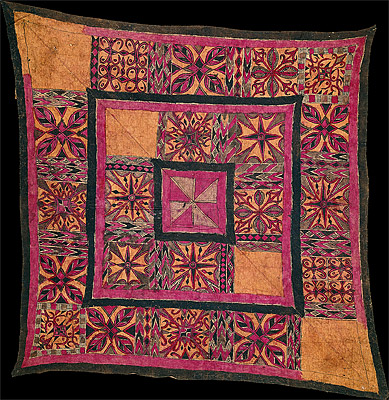
Museum Description: To Bada or To Kaili people,
Bada or Kulawi district, Sulawesi, Indonesia. Man’s ceremonial headcloth [siga] late 19th-early 20th century. 85.0 (h) x 85.0 (w) cm. Acquired through gift and purchase from the Collection of Robert J Holmgren and Anita E Spertus, New York 2000, National Gallery of Australia, Canberra NGA 2000.707
The information about this piece is interesting so here it is quoted in full:
The designs on men’s headcloths [siga] are painted onto paper-thin barkcloth. Felting bark pulp was one of the earliest techniques for creating fabric in Southeast Asia, and the stone beaters for pounding bark into cloth have been found in long-established habitation sites.
Arranged in bands, the most prominent motifs on the I[?] allude to the water buffalo. A symbol of fertility connected with wet rice cultivation, the buffalo is crucial to agricultural success and prosperity. As a marker of wealth and the principal sacrificial animal, certain features of buffalo are accentuated in art. Combinations of double-hook horns, oval-shaped ears and round eyes form the overall designs. Other motifs on siga may represent the sun, valuable beads and sirih leaves, an ingredient in the ancient custom of betel-nut chewing.
Other Interesting Information
In 1905 two scholarly Dutch missionaries who had spent almost a decade studying local cultures and languages in Indonesian concluded that the barkcloth was undoubtedly the original clothing material of the entire Indonesian archipelago (Adriani and Kruyt 1905). Moreover, all of the regions where barkcloth was known to be produced and used for either clothing or paper, the interior of Central Sulawesi was described as the source of the most elaborate creations of this unusual fabric technology (Adriani and Kruyt 1905; Raven 1932, Kooijman 1963).
“It is in this kingdom [Kaili] where men and women are clad in nothing but paper, and that not being lasting, the women are always working at it very curiously. It is made of the rind of a small tree we saw there, which they beat with a stone curiously wrought, and make it as they please, either coarse, fine or very fine. They dye it all colours, and twenty paces off it looks like fine tabby. A great deal of it is carry’d to Manila and Macao where I have seen excellent bed-hangings made from it; they are the best you would desire in cold weather. When it rains, water being the destruction of paper, those people strip and carry their clothes under their arm. (Navarette, in Cummins 1962:110 – comments written by the Spanish friar Domingo Navarrette after a one-month visit to the Palu Valley in 1657).
Reference: V. Aragon, .Lorraine “Barkcloth Production in Central Sulawesi” Expedition Magazine 32.1 (1990): n. pag. Expedition Magazine. Penn Museum, 1990 Web. 11 Feb 2019 <http://www.penn.museum/sites/expedition/?p=2889> – has a link to PDF of original article here.


Recent Comments